Showing posts with label irony. Show all posts
Showing posts with label irony. Show all posts
Saturday, February 25, 2012


Tuesday, August 30, 2011
The Modern Tea Party: An Error of Historical Analogy
Over the last several years I have often marveled at the lack of knowledge and understanding of history that is afoot among self proclaimed patriots dressed in 18th Century costumes claiming to be the rightful heirs to the Founding Fathers of this country.
The original Tea Party was held in Boston Harbor in protest of a tax on tea imported from England. The battle cry was “No Taxation Without Representation”. Parliament in Great Britain unilaterally passed the tax to be levied on colonists living in the American colonies in order to mitigate the costs of a British army sent to America to defend the colonies from the French during the French and Indian War. The British colonists in America resented the tax on the grounds that it was imposed on them while they had no elected representatives in Parliament. They were simply not allowed to vote.
In it’s current incarnation, the Tea Party has currently had all the representation they voted for. “No Taxation Without Representation” does not apply.
As for being the legitimate heirs to the Founding Fathers, they forget that it was the Founding Fathers who drew up a Constitution that established a relatively strong Federal government while reserving some rights for the states (and through the Bill of Rights; the first ten amendments to that Constitution) protected citizens from the power of the central government as well as from the powers of the various states.
In my opinion, the modern Tea Party has little in common with the original Tea Party nor do they have any understanding of what the Founding Fathers intended. However, I do believe that there is a more accurate historical analogy that could be applied.
The current Tea Party is opposed to the duly elected government of the United States. John Wilkes Booth was also opposed to the duly elected government of the United States. The Tea Party of today are strong advocates of states rights, the primary motivation of the Confederacy during the American civil war. John Wilkes Booth, as a strong southern sympathizer, also believed that states rights were more important than a central government. The modern Tea Party believes secession is a valid option for a state within the Union. John Wilkes Booth shared that opinion. There is ample evidence that today’s Tea Party are, at the very least, latent racists. In his strong support of slavery of black people in the south, John Wilkes Booth was a blatant racist. Today’s Tea Party believe it is appropriate to resort to Second Amendment remedies if they don’t get their way in legislation. Again, John Wilkes Booth shared that opinion and took his case to the logical conclusion.
Making the case that today’s Tea Party is somehow related to the original Boston Tea Party patriots and the Founding Fathers is a stretch and requires too many qualifiers. Making the case that the modern Tea Party is more analogous to John Wilkes Booth and his band of conspirators that assassinated Abraham Lincoln at the end of the American Civil War requires far less in terms of intellectual gymnastics.
The original Tea Party was held in Boston Harbor in protest of a tax on tea imported from England. The battle cry was “No Taxation Without Representation”. Parliament in Great Britain unilaterally passed the tax to be levied on colonists living in the American colonies in order to mitigate the costs of a British army sent to America to defend the colonies from the French during the French and Indian War. The British colonists in America resented the tax on the grounds that it was imposed on them while they had no elected representatives in Parliament. They were simply not allowed to vote.
In it’s current incarnation, the Tea Party has currently had all the representation they voted for. “No Taxation Without Representation” does not apply.
As for being the legitimate heirs to the Founding Fathers, they forget that it was the Founding Fathers who drew up a Constitution that established a relatively strong Federal government while reserving some rights for the states (and through the Bill of Rights; the first ten amendments to that Constitution) protected citizens from the power of the central government as well as from the powers of the various states.
In my opinion, the modern Tea Party has little in common with the original Tea Party nor do they have any understanding of what the Founding Fathers intended. However, I do believe that there is a more accurate historical analogy that could be applied.
The current Tea Party is opposed to the duly elected government of the United States. John Wilkes Booth was also opposed to the duly elected government of the United States. The Tea Party of today are strong advocates of states rights, the primary motivation of the Confederacy during the American civil war. John Wilkes Booth, as a strong southern sympathizer, also believed that states rights were more important than a central government. The modern Tea Party believes secession is a valid option for a state within the Union. John Wilkes Booth shared that opinion. There is ample evidence that today’s Tea Party are, at the very least, latent racists. In his strong support of slavery of black people in the south, John Wilkes Booth was a blatant racist. Today’s Tea Party believe it is appropriate to resort to Second Amendment remedies if they don’t get their way in legislation. Again, John Wilkes Booth shared that opinion and took his case to the logical conclusion.
Making the case that today’s Tea Party is somehow related to the original Boston Tea Party patriots and the Founding Fathers is a stretch and requires too many qualifiers. Making the case that the modern Tea Party is more analogous to John Wilkes Booth and his band of conspirators that assassinated Abraham Lincoln at the end of the American Civil War requires far less in terms of intellectual gymnastics.
Friday, July 29, 2011
Quote of the day
""In the United States, doing good has come to be, like patriotism, a favorite device of persons with something to sell."
~ H. L. Menckin
~ H. L. Menckin
Thursday, July 28, 2011
Thursday, June 23, 2011
Thursday, May 12, 2011
Questioning Some Economic Assumptions
Let me see if I have this right. I could be wrong, so feel free to correct me.
For thirty years you believed Republicans when they said deficits don't matter. While they were promoting this idea, you were happy with the tax cuts they made, believing that "starving the beast" was a good thing because Republicans told you it was.
Now you've changed your tune and you believe that deficits do matter but hasn't occurred to you that they lied to you for thirty years about deficits. Deficits do matter and they told you they didn't.
In the meantime, they've cut taxes - i.e. revenue - and made up the difference by borrowing so that the government could maintain it's obligations to it's people. Even though they've cut revenue income and replaced it with borrowed funds that must be repaid, you now believe them when they tell you that we have a spending crisis and not a revenue crisis?
Beyond that, when it comes to creating jobs you believe Republicans when they tell you that further tax cuts (additional reductions in revenue forcing more borrowing) will somehow create jobs. Yet the numbers are pretty clear. During the Clinton administration (eight years), more jobs were created than during the Reagan administration (eight years), the Bush I administration (four years) and the Bush II administration (eight years) ... combined! But, in spite of the numbers, you believe them.
When Republicans tell you that "tax credits" are a good thing you believe them because you believe anything that reduces taxes for anyone must be a good thing ... and because that's what Republicans have been telling you for years. They don't bother to mention that even though "tax credits" may reduce taxes for some, they leave a gap in tax revenue that must be made up for either by additional borrowing or higher taxes for others.
For years Republicans have told you that government is inefficient and you believe them ... in spite of the fact that Medicare (a government administered program) delivers excellent health care for 41.61 million people with only a 3% overhead while private insurance companies require more the 15% to provide service that's not as good. Paying 5x for the same or inferior service doesn't seem like the epitome of efficiency. (Ask anyone who's paid for their own insurance for any period of time before qualifying for Medicare which of the two they prefer.) Keep in mind that for the most part Medicare delivers services to people who are 65+; people who tend to need more health care services, while private insurance companies a.) serve a younger demographic who tend to need less health care overall, b.) have eliminated people with preexisting conditions (i.e., people who actually need health care) and retain people who don't need health care and c.) limit coverage with it gets too expensive - making the disparity even more striking.
Every system has waste but when Republicans talk about waste, they only talk about it in terms of government waste, without comparison to anything else ... but you believe them when they say government is wasteful. It is. But compared to what?
For thirty years you believed Republicans when they said deficits don't matter. While they were promoting this idea, you were happy with the tax cuts they made, believing that "starving the beast" was a good thing because Republicans told you it was.
Now you've changed your tune and you believe that deficits do matter but hasn't occurred to you that they lied to you for thirty years about deficits. Deficits do matter and they told you they didn't.
In the meantime, they've cut taxes - i.e. revenue - and made up the difference by borrowing so that the government could maintain it's obligations to it's people. Even though they've cut revenue income and replaced it with borrowed funds that must be repaid, you now believe them when they tell you that we have a spending crisis and not a revenue crisis?
Beyond that, when it comes to creating jobs you believe Republicans when they tell you that further tax cuts (additional reductions in revenue forcing more borrowing) will somehow create jobs. Yet the numbers are pretty clear. During the Clinton administration (eight years), more jobs were created than during the Reagan administration (eight years), the Bush I administration (four years) and the Bush II administration (eight years) ... combined! But, in spite of the numbers, you believe them.
When Republicans tell you that "tax credits" are a good thing you believe them because you believe anything that reduces taxes for anyone must be a good thing ... and because that's what Republicans have been telling you for years. They don't bother to mention that even though "tax credits" may reduce taxes for some, they leave a gap in tax revenue that must be made up for either by additional borrowing or higher taxes for others.
For years Republicans have told you that government is inefficient and you believe them ... in spite of the fact that Medicare (a government administered program) delivers excellent health care for 41.61 million people with only a 3% overhead while private insurance companies require more the 15% to provide service that's not as good. Paying 5x for the same or inferior service doesn't seem like the epitome of efficiency. (Ask anyone who's paid for their own insurance for any period of time before qualifying for Medicare which of the two they prefer.) Keep in mind that for the most part Medicare delivers services to people who are 65+; people who tend to need more health care services, while private insurance companies a.) serve a younger demographic who tend to need less health care overall, b.) have eliminated people with preexisting conditions (i.e., people who actually need health care) and retain people who don't need health care and c.) limit coverage with it gets too expensive - making the disparity even more striking.
Every system has waste but when Republicans talk about waste, they only talk about it in terms of government waste, without comparison to anything else ... but you believe them when they say government is wasteful. It is. But compared to what?
Tuesday, May 03, 2011
Random thoughts on bin Laden
"I've never wished a man dead, but I have read some obituaries with great pleasure."
— Mark Twain
OBAMA: "I made killing or capturing Bin Laden our top priority"
GOP: "NO Gay Marriage" (because their so tough on terrorism)
Some are suggesting that Bush get substantial credit for tracking down bin Laden. Perhaps they have a point. After all, Bush made thorough search of all the places that Osama bin Laden probably wouldn't be... like Iraq, for example. Then, Bush having ruled out all the places bin Laden wasn't, Barack Obama only had to focus on the places in which bin Laden probably was. The process of elimination is a well regarded forensic tool and, seeing that there were more places in which bin Laden wasn't, the argument could be made that Bush did the lion's share of the work.
— Mark Twain
OBAMA: "I made killing or capturing Bin Laden our top priority"
GOP: "NO Gay Marriage" (because their so tough on terrorism)
Some are suggesting that Bush get substantial credit for tracking down bin Laden. Perhaps they have a point. After all, Bush made thorough search of all the places that Osama bin Laden probably wouldn't be... like Iraq, for example. Then, Bush having ruled out all the places bin Laden wasn't, Barack Obama only had to focus on the places in which bin Laden probably was. The process of elimination is a well regarded forensic tool and, seeing that there were more places in which bin Laden wasn't, the argument could be made that Bush did the lion's share of the work.
Thursday, April 21, 2011
Facing the Unknowable
A fundamentalist, Christian acquaintance of mine sent me a note with a link to an article describing the worship services of the Pentecostal Church in rather derogatory terms. The subject line on his note was, "There's certainly whackos in my world too...lol".
Perhaps I was incorrect in assuming that he was trying to point out that we were both somehow on the same side or maybe that he was more rational than some other people (and therefore somehow superior).
I was a little taken aback. We've known each other for more than a decade. I'm familiar with his fundamentalism and he knows I have a rather dim view of organized religions in general. It took me two days to collect my thoughts and respond. The following is my response:
Perhaps I was incorrect in assuming that he was trying to point out that we were both somehow on the same side or maybe that he was more rational than some other people (and therefore somehow superior).
I was a little taken aback. We've known each other for more than a decade. I'm familiar with his fundamentalism and he knows I have a rather dim view of organized religions in general. It took me two days to collect my thoughts and respond. The following is my response:
In the war over who's imaginary friend is more real, the actions of the Pentecostals look no more strange to me than the dresses the Popes wear or Aztecs imagining that ripping the living hearts out of their virgin daughters in the hope it would bring rain or 21st century people looking to the pronouncements of desert dwellers from 2,000 years ago, who herded sheep and goats for a living and thought the earth was flat, for predictions about our near future.
The holders of each of those belief sets embraces his beliefs equally seriously and equally sincerely. Each believes with equal conviction that they have a handle on the absolute truth. For any of them to imagine that their beliefs are somehow superior to another's is an act of simple hubris, allowing one believer to feel the smugness of holding themselves apart a from their brothers and looking looking down on them.
They all get an equal level of respect from me, and frankly, less respect than it might be for the reason stated above.
It seems to me that, when facing the humanly unknowable, one should be more humble and consider: "What if I'm wrong?"
Monday, April 18, 2011
Ayn Rand set the standard
I've been doing some research, looking for the one place on the planet where those who live their lives by the values expressed by Ayn Rand would feel most at home. Given that the United States with all its taxes and regulations and it's nanny-welfare state is obviously a highly uncomfortable environment for them, I've had to broaden my horizons and look elsewhere. But first, the criteria for the ideal state:
1.) Government so small that it can be drown in a bathtub.
2.) An environment that is "business friendly", that is to say one that is unencumbered by regulations or restrictions on business.
3.) Possessing a society that encourages "free enterprise", allowing for the minimum investment of capital to provide opportunities for maximum profit.
4.) Minimized or absence of income, corporate, capital gains or death taxation which would allow those who earn the opportunity to keep what they earn without suffering the forced redistribution of wealth by government bureaucracies.
As uncomfortable as it is to live in the taxed, restricted and regulated conditions found in the USA, I had to rule out a list of countries that were significantly more taxed, regulated and restricted. This list included virtually all of the countries of Europe (as well as Canada). Though the countries of Europe are said to enjoy a high standard of living and rank high on virtually every index measuring quality of life, they are virtually all "socialist" countries that tax their citizens without mercy to support their nanny-welfare state programs of universal health care and/or universal education. It is obvious, even with the most cursory examinations that the people of these countries have been deluded by a liberal press into believing that life is good - not realizing that life could be so much better if they would only adopt the principals outlined by Ann Rand in her novels, "Atlas Shrugged" and "Fountainhead".
Most of the countries of South and Central America are burdened with "socialized medicine". Besides, Banana Republics have a bad habit of nationalizing things.
China must be ruled out as well. Though China offers a "business friendly" atmosphere, with few restrictions or regulations and minimal concerns about business impacts on the overall environment, their centralized government can change policy on a dime and nationalize the fruits of an entrepreneur's labors over night. China also mandates through it's laws that their government be part owner in any business franchise originating outside the country. This usurpation of ownership by the government and the uncertainty of tomorrow's business policy is an anathema to honest free enterprise.
Many of the other countries of Southeast and South Asia fall in the category of totalitarian dictatorships. These must be ruled out as possibilities, too. Tax policy and other restrictions and regulations imposed on business span the spectrum from capricious and unpredictable to draconian and rapacious.
This applies equally to the countries of the Middle East, where successful businesses are family business and, in many cases, only one family (the ruling family) is allowed to have a successful business larger than a push cart.
After ruling out most of the countries on the planet as being hostile to the Ian Rand approach - either for their tax policy, the size and strength of their government or their nanny-welfare approach to their people - I believe I have isolated one country that provides an ideal Randian environment. Well, perhaps not ideal, but certainly more idea than all the others and it meets all of the criteria that I've listed above.
In this singular country one may, with a minimal investment, band together with several other investors and launch a free enterprise venture which, if successful, holds the potential for an extremely high ROI (Return On Investment). The successful venture will not be limited by government interference through either regulation or taxation - the government is, in fact, small enough to drown in a bathtub! The government of this country provides no burdening, tax supported public services, providing an atmosphere where real individual responsibility can flourish.
This Randian paradise offers a mild climate and uncounted miles of un-zoned beach front property just waiting to be developed without pesky environmental restriction - a perfect place for Atlas to Shrug to his heart's content, away from the pesky proletariat that is always threatening to unionize and agitate for handouts they've not worked for. Here, the entrepreneur is not burdened by demands for five day work weeks or overtime pay by those he employs. No more paid vacations for the worker bees! Here, true to the Randian Ideal, success provides its rewards in full measure and, as they should, those who fail fall by the wayside.
In an act of good faith and brotherhood, I herewith offer to coordinate the relocation - of ANY who long for this level of freedom, who want their personal responsibility to shine in this Fountainhead Paradise - to this Randian Nervanah - Somalia.
1.) Government so small that it can be drown in a bathtub.
2.) An environment that is "business friendly", that is to say one that is unencumbered by regulations or restrictions on business.
3.) Possessing a society that encourages "free enterprise", allowing for the minimum investment of capital to provide opportunities for maximum profit.
4.) Minimized or absence of income, corporate, capital gains or death taxation which would allow those who earn the opportunity to keep what they earn without suffering the forced redistribution of wealth by government bureaucracies.
As uncomfortable as it is to live in the taxed, restricted and regulated conditions found in the USA, I had to rule out a list of countries that were significantly more taxed, regulated and restricted. This list included virtually all of the countries of Europe (as well as Canada). Though the countries of Europe are said to enjoy a high standard of living and rank high on virtually every index measuring quality of life, they are virtually all "socialist" countries that tax their citizens without mercy to support their nanny-welfare state programs of universal health care and/or universal education. It is obvious, even with the most cursory examinations that the people of these countries have been deluded by a liberal press into believing that life is good - not realizing that life could be so much better if they would only adopt the principals outlined by Ann Rand in her novels, "Atlas Shrugged" and "Fountainhead".
Most of the countries of South and Central America are burdened with "socialized medicine". Besides, Banana Republics have a bad habit of nationalizing things.
China must be ruled out as well. Though China offers a "business friendly" atmosphere, with few restrictions or regulations and minimal concerns about business impacts on the overall environment, their centralized government can change policy on a dime and nationalize the fruits of an entrepreneur's labors over night. China also mandates through it's laws that their government be part owner in any business franchise originating outside the country. This usurpation of ownership by the government and the uncertainty of tomorrow's business policy is an anathema to honest free enterprise.
Many of the other countries of Southeast and South Asia fall in the category of totalitarian dictatorships. These must be ruled out as possibilities, too. Tax policy and other restrictions and regulations imposed on business span the spectrum from capricious and unpredictable to draconian and rapacious.
This applies equally to the countries of the Middle East, where successful businesses are family business and, in many cases, only one family (the ruling family) is allowed to have a successful business larger than a push cart.
After ruling out most of the countries on the planet as being hostile to the Ian Rand approach - either for their tax policy, the size and strength of their government or their nanny-welfare approach to their people - I believe I have isolated one country that provides an ideal Randian environment. Well, perhaps not ideal, but certainly more idea than all the others and it meets all of the criteria that I've listed above.
In this singular country one may, with a minimal investment, band together with several other investors and launch a free enterprise venture which, if successful, holds the potential for an extremely high ROI (Return On Investment). The successful venture will not be limited by government interference through either regulation or taxation - the government is, in fact, small enough to drown in a bathtub! The government of this country provides no burdening, tax supported public services, providing an atmosphere where real individual responsibility can flourish.
This Randian paradise offers a mild climate and uncounted miles of un-zoned beach front property just waiting to be developed without pesky environmental restriction - a perfect place for Atlas to Shrug to his heart's content, away from the pesky proletariat that is always threatening to unionize and agitate for handouts they've not worked for. Here, the entrepreneur is not burdened by demands for five day work weeks or overtime pay by those he employs. No more paid vacations for the worker bees! Here, true to the Randian Ideal, success provides its rewards in full measure and, as they should, those who fail fall by the wayside.
In an act of good faith and brotherhood, I herewith offer to coordinate the relocation - of ANY who long for this level of freedom, who want their personal responsibility to shine in this Fountainhead Paradise - to this Randian Nervanah - Somalia.
Friday, March 04, 2011
Friday, January 28, 2011
The absurdity of contemporary “free thinking” -or- things aren’t always what we say they are
I have recently encountered several people in the media, in discussions on the web and in person who label themselves as “free thinkers”.
Traditionally “freethought” or “free thinking” had a meaning. Wikipedia tells us that “Freethought is a philosophical viewpoint that holds that opinions should be formed on the basis of science, logic, and reason, and should not be influenced by authority, tradition, or any dogma.
It’s ironic that the term “traditionally” might be appropriate when refering to a definition of “freethought”. Perhaps “historically” would rest more easily on the ears? But I think there’s a case for it’s use. In western thought the idea of “freethought” has its origins in the period of The Enlightenment with thinkers like Voltaire in Europe and in the new world, Jefferson and Adams, who rejected the ideas of the past, specifically ideas like the divine right of kings and formulated the ideas of self determination to replace them. In a conservative society predicated on a hierarchy of aristocrats, clergy and commoners with traditions that had a place for everyone and kept everyone in their place, they imagined a world in which “all men are created equal” and where ideas survived on the basis of their merit rather than the presumed pedigree or inherited power of their proponent. They were the liberals of their time, embracing change to the extent that they actively mapped out how it could happen. They placed themselves in direct opposition to those who fought to maintain the status quo.
There are those among us now who consider themselves “free thinkers.” I don’t claim that status for myself. I only claim to be a thinker at best. It seems to me that to add a modifier to anything generally limits it. For example, if I use the word “apple”, one could anticipate that the picture balloons that appear in the heads of our readers could range from “red apple” to “yellow apple” to “candied apple” and “caramel apple”. If I modify the word “apple” to read “Granny Smith apple”, how many of those picture balloons instantly pop, replaced by a totally different image of a “green apple”? The word “apple” has been modified (and limited) by the words “Granny Smith”. I believe now the same principle functions when we modify “thought” to “freethought”.
We are told that things evolve over time. Is it possible that historical free thinking has evolved into something we might not recognize by reading the “traditional” definition of the term?
So, lets ask ourselves (if we are capable of questioning ourselves and our assumptions), just what is the meaning of “free thinking” these days? Is it freedom from something? Or is it the freedom to do something?
Perhaps it is the freedom from something. Is it the freedom from the culture in which we were raised? I don’t think that’s possible. The background of our culture, brought to us by our parents and by our religion (or lack of religious belief) or by our education all provide our tools for thought and the measures by which we judge our thoughts and the ideas of others.
As an example of how one can go terribly wrong by ignoring their cultural background, I offer a statement made by Kathleen Parker, a Caucasian, conservative, newspaper columnist and TV opinion show host, retained presumably for her ability to “think freely”; to analyze how things are in reality and to comment accordingly in order to provide perspective to her readers.
In a recent column dealing with racial issues Parker said, “I don’ t see things through a racial filter.” This blithely ignores the fact that we are all of one race or another. Her presumption here is that only people of races other than hers see things through a racial filter and that somehow, presumably because she’s white, she does not. I’m sure that, without realizing it, Ms. Parker called into question the validity of any opinion she had on the topic of race with such a statement. The fact of the matter is that Ms. Parker most certainly sees things through a racial filter … the filter that is part and parcel of being a Caucasian and, more specifically, a Caucasian in America. As much as Ms. Parker imagines her thinking is “free”, in this case free of prejudice … the reality does not pass even the most casual examination.
Does being a “free thinker” mean that we have freed our imagination to think about anything in any way that we can imagine? Does it mean that we are free to imagine our own facts. Or does it mean that, because we have freed our imagination, we are free to pick our facts and ignore that facts that don’t fit with what we imagine to be true? It would be contrary to the historical definition of “freethought” but evidence suggests that selective reality is perfectly consistent with contemporary interpretations of the term
Does “free thinking” mean the freedom from preconceived notions? Perhaps it does, but that is true only if we continually question our assumptions and our sense of being right. If we do not continually question what we believe and consider the possibility that we might be wrong then we run the risk of going a long way down the proverbial garden path. If we cannot admit to ourselves that our opinions might be wrong, it becomes doubly difficult for us when someone else provides evidence that we are, in fact, wrong. If we do not continually question what we believe, we run the risk of painting ourselves into a corner.
In a 2006 interview, Chalmers Johnson, author of “Blowback”, a long time CIA consultant and historian of the post-cold war era defended himself against the assertion that he had changed his position from the time when he was considered the consummate “cold warrior”. “When I get new information, I change my position.” he said. “What do you do?”
If the primary objective of thought is to find truth, then the process must be to gather the evidence and allow the evidence available to determine our conclusions. To pursue a conclusion by seeking only evidence that supports our opinion while ignoring the evidence that does not only serves to promote an agenda but at best it can only provide a half truth. Beyond that, if the evidence we have can be demonstrated to be false, we must remove it from our consideration and recalculate all of our conclusions that depend on it. All evidence must be tested for truth.
Or perhaps the contemporary term “free thinker” is simply used by some as a self serving means to distinguish themselves from others who are merely “thinkers”, implying that somehow “free thought” is of a better quality than just plain old thought. But that begs a question. How is “free thinking” better than “thinking”? What is it about “free thinking” that provides a greater guard against logical fallacies, the dread faulty premise and preconceived notions? What quality does “free thinking” possess that is a defense against prejudice and bigotry, doctrine and dogma? What is it about modifying that idea of “thinker” that liberates thought rather than restricts it?
It's presumptuous to adopt an appellation that has historically referred to giants of liberal though while promoting conservative agendas. To label ourselves “free thinking” while cutting and pasting conservative orthodoxy, foisting it on our readers as our own thinking, is to create an oxymoron on par with a “giant shrimp”. And when we betray the title by abandoning the evidence and the rules of logic by being dogmatic and doctrinaire, we render “freethought” the punchline of a joke that we wear on our sleeves.
Or to summarize, using a quote from “The Princess Bride”; “That word you used? I don’t think it means what you think it means.”
(If anyone is interested in precedents for this particular abuse of language; using a word for a thing that is in total conflict with the reality of the thing, I would recommend Googling the Orwellian term “newspeak”.)
Traditionally “freethought” or “free thinking” had a meaning. Wikipedia tells us that “Freethought is a philosophical viewpoint that holds that opinions should be formed on the basis of science, logic, and reason, and should not be influenced by authority, tradition, or any dogma.
It’s ironic that the term “traditionally” might be appropriate when refering to a definition of “freethought”. Perhaps “historically” would rest more easily on the ears? But I think there’s a case for it’s use. In western thought the idea of “freethought” has its origins in the period of The Enlightenment with thinkers like Voltaire in Europe and in the new world, Jefferson and Adams, who rejected the ideas of the past, specifically ideas like the divine right of kings and formulated the ideas of self determination to replace them. In a conservative society predicated on a hierarchy of aristocrats, clergy and commoners with traditions that had a place for everyone and kept everyone in their place, they imagined a world in which “all men are created equal” and where ideas survived on the basis of their merit rather than the presumed pedigree or inherited power of their proponent. They were the liberals of their time, embracing change to the extent that they actively mapped out how it could happen. They placed themselves in direct opposition to those who fought to maintain the status quo.
There are those among us now who consider themselves “free thinkers.” I don’t claim that status for myself. I only claim to be a thinker at best. It seems to me that to add a modifier to anything generally limits it. For example, if I use the word “apple”, one could anticipate that the picture balloons that appear in the heads of our readers could range from “red apple” to “yellow apple” to “candied apple” and “caramel apple”. If I modify the word “apple” to read “Granny Smith apple”, how many of those picture balloons instantly pop, replaced by a totally different image of a “green apple”? The word “apple” has been modified (and limited) by the words “Granny Smith”. I believe now the same principle functions when we modify “thought” to “freethought”.
We are told that things evolve over time. Is it possible that historical free thinking has evolved into something we might not recognize by reading the “traditional” definition of the term?
So, lets ask ourselves (if we are capable of questioning ourselves and our assumptions), just what is the meaning of “free thinking” these days? Is it freedom from something? Or is it the freedom to do something?
Perhaps it is the freedom from something. Is it the freedom from the culture in which we were raised? I don’t think that’s possible. The background of our culture, brought to us by our parents and by our religion (or lack of religious belief) or by our education all provide our tools for thought and the measures by which we judge our thoughts and the ideas of others.
As an example of how one can go terribly wrong by ignoring their cultural background, I offer a statement made by Kathleen Parker, a Caucasian, conservative, newspaper columnist and TV opinion show host, retained presumably for her ability to “think freely”; to analyze how things are in reality and to comment accordingly in order to provide perspective to her readers.
In a recent column dealing with racial issues Parker said, “I don’ t see things through a racial filter.” This blithely ignores the fact that we are all of one race or another. Her presumption here is that only people of races other than hers see things through a racial filter and that somehow, presumably because she’s white, she does not. I’m sure that, without realizing it, Ms. Parker called into question the validity of any opinion she had on the topic of race with such a statement. The fact of the matter is that Ms. Parker most certainly sees things through a racial filter … the filter that is part and parcel of being a Caucasian and, more specifically, a Caucasian in America. As much as Ms. Parker imagines her thinking is “free”, in this case free of prejudice … the reality does not pass even the most casual examination.
Does being a “free thinker” mean that we have freed our imagination to think about anything in any way that we can imagine? Does it mean that we are free to imagine our own facts. Or does it mean that, because we have freed our imagination, we are free to pick our facts and ignore that facts that don’t fit with what we imagine to be true? It would be contrary to the historical definition of “freethought” but evidence suggests that selective reality is perfectly consistent with contemporary interpretations of the term
Does “free thinking” mean the freedom from preconceived notions? Perhaps it does, but that is true only if we continually question our assumptions and our sense of being right. If we do not continually question what we believe and consider the possibility that we might be wrong then we run the risk of going a long way down the proverbial garden path. If we cannot admit to ourselves that our opinions might be wrong, it becomes doubly difficult for us when someone else provides evidence that we are, in fact, wrong. If we do not continually question what we believe, we run the risk of painting ourselves into a corner.
In a 2006 interview, Chalmers Johnson, author of “Blowback”, a long time CIA consultant and historian of the post-cold war era defended himself against the assertion that he had changed his position from the time when he was considered the consummate “cold warrior”. “When I get new information, I change my position.” he said. “What do you do?”
If the primary objective of thought is to find truth, then the process must be to gather the evidence and allow the evidence available to determine our conclusions. To pursue a conclusion by seeking only evidence that supports our opinion while ignoring the evidence that does not only serves to promote an agenda but at best it can only provide a half truth. Beyond that, if the evidence we have can be demonstrated to be false, we must remove it from our consideration and recalculate all of our conclusions that depend on it. All evidence must be tested for truth.
Or perhaps the contemporary term “free thinker” is simply used by some as a self serving means to distinguish themselves from others who are merely “thinkers”, implying that somehow “free thought” is of a better quality than just plain old thought. But that begs a question. How is “free thinking” better than “thinking”? What is it about “free thinking” that provides a greater guard against logical fallacies, the dread faulty premise and preconceived notions? What quality does “free thinking” possess that is a defense against prejudice and bigotry, doctrine and dogma? What is it about modifying that idea of “thinker” that liberates thought rather than restricts it?
It's presumptuous to adopt an appellation that has historically referred to giants of liberal though while promoting conservative agendas. To label ourselves “free thinking” while cutting and pasting conservative orthodoxy, foisting it on our readers as our own thinking, is to create an oxymoron on par with a “giant shrimp”. And when we betray the title by abandoning the evidence and the rules of logic by being dogmatic and doctrinaire, we render “freethought” the punchline of a joke that we wear on our sleeves.
Or to summarize, using a quote from “The Princess Bride”; “That word you used? I don’t think it means what you think it means.”
(If anyone is interested in precedents for this particular abuse of language; using a word for a thing that is in total conflict with the reality of the thing, I would recommend Googling the Orwellian term “newspeak”.)
Monday, November 29, 2010
Monday, August 30, 2010
Mosque in Manhattan
Anyone who knows me knows I have no particular love for Islam. It ranks right up there with Catholicism, Evangelical Christianity and any other organized magical thinking you can list as far as I'm concerned. However, I do have a fondness for facts.
From Huffington Post:
"The 'Ground Zero mosque' is a genuine proposal," Brooker notes, "but it's slightly less provocative than its critics' nickname makes it sound. For one thing, it's not at Ground Zero. Also, it isn't a mosque."
Brooker goes on to note, correctly, that the project is a "cultural centre" with a "basketball court," whose purpose is to "improve interfaith relations."
And, to repeat, it's not at Ground Zero!
Perhaps spatial reality functions differently on the other side of the Atlantic, but here in London, something that is "two minutes' walk and round a corner" from something else isn't actually "in" the same place at all. I once had a poo in a pub about two minutes' walk from Buckingham Palace. I was not subsequently arrested and charged with crapping directly onto the Queen's pillow. That's how "distance" works in Britain. It's also how distance works in America, of course, but some people are currently pretending it doesn't, for daft political ends.
Read the rest from Charlie Brooker at Huffington Post after the click.
From Huffington Post:
"The 'Ground Zero mosque' is a genuine proposal," Brooker notes, "but it's slightly less provocative than its critics' nickname makes it sound. For one thing, it's not at Ground Zero. Also, it isn't a mosque."
Brooker goes on to note, correctly, that the project is a "cultural centre" with a "basketball court," whose purpose is to "improve interfaith relations."
And, to repeat, it's not at Ground Zero!
Perhaps spatial reality functions differently on the other side of the Atlantic, but here in London, something that is "two minutes' walk and round a corner" from something else isn't actually "in" the same place at all. I once had a poo in a pub about two minutes' walk from Buckingham Palace. I was not subsequently arrested and charged with crapping directly onto the Queen's pillow. That's how "distance" works in Britain. It's also how distance works in America, of course, but some people are currently pretending it doesn't, for daft political ends.
Read the rest from Charlie Brooker at Huffington Post after the click.
Saturday, March 06, 2010
Glenn Beck Logic ... perfect
Visit msnbc.com for breaking news, world news, and news about the economy
Saturday, February 20, 2010
The Tea Party isn't a movement ... it's a cult.
"In a recent poll almost ninety percent of Tea Baggers said that they thought taxes had either gone up or stayed the same under Obama. Only two percent thought they went down. But the reality is taxes have gone down for ninety five percent of working families taxes went down.
"Think about that. Only two percent of the people in a "movement" about taxes named after a tax revolt have the slightest idea what's going on ... with taxes."
Or watch the video on Crooks and Liars after the click.
Thursday, January 28, 2010
The Misdirected Anger of the Tea Party
or The Myth of Conservative Republican Fiscal Responsibility
There are all kinds of things that I hear on the political front that, frankly, I get tired of hearing. When I get tired enough of a mantra, I get the itch to start looking up things that will either substantiate or refute the rhetoric.
One of the things that has troubled me has been the assertion that Conservative Republicans are "fiscally responsible" while Liberal Democrats only want to "tax and spend". Its a mantra that's repeated often but, rarely is any proof offered in the discussion. I thought I'd look up the numbers. Numbers are great. They have sources that we can all refer to so that we're all singing from the same sheet, so to speak.
It struck me that the mounting National Debt (as a percentage of Gross Domestic Product) might be a good measure of overall fiscal responsibility. If we're being responsible, then logically the National Debt %GDP should be decreasing during a given administration. On the other hand, if we're being irresponsible that number should be on the rise ... that is to say, as it goes down, we're living more within our means. If it is increasing, we are borrowing and mortgaging the future of the country and of future generations. So, who has done their part to see that we're at least trying to live within our means and who has been on a spending spree?
Conventional wisdom would have it that Republican administrations, being fiscally responsible, would be the administrations that reduced our collective indebtedness while Democrats, who we all KNOW only want to "tax and spend" would be the ones who are increasing our overall debt.
The surprise is that the numbers don't support that proposition.
The graph below outlines which administrations lowered the national Debt as a percentage of GDP and which increased it relative to the previous administration. The Blue columns represent Democrat (sic) administrations between the end of World War Two (1945) and 2009. The Red columns represent Republican administrations.
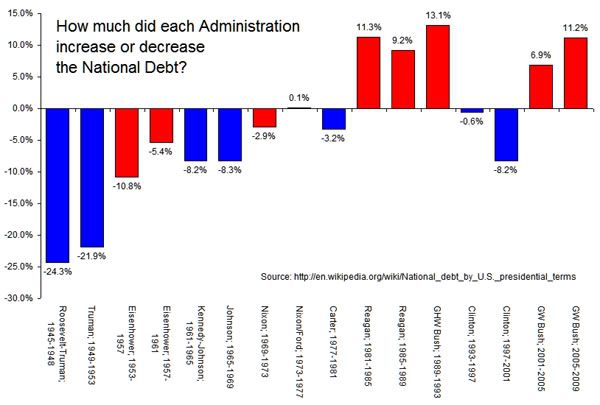
The pattern becomes clear when you draw a picture of it! Every single Democrat (sic) administration since the Second World War has managed to decrease the National Debt as a percent of GDP while every Republican administration since Nixon's second term (1973-1977) has managed to raise our level of indebtedness - not just by a little - in most cases by a lot - while at the same time telling us they know how to manage money! Sort of like pissing on your head and telling you that its only raining out!
Now, the Tea Party is angry ... and they have every cause to be angry. We're in deep du-du and there's no easy way out. They're angry about the state of our indebtedness. They're angry that they have to pay taxes (though the ones who seem most angry seem to be the ones who pay the least). They're angry at Democrats because they've been told, ever since Reagan, that Democrats "tax and spend" ... and they're gullible enough to believe it without checking the numbers. They're angry with government because they've been told, ever since Reagan, that "government isn't the solution. Government is the problem!" And they've believed it ... without bothering to check the facts.
If they looked at the facts ... where the national financial problems originated ... they would be taring and feathering Republicans instead of inviting them to their rallys. If anyone is responsible for the current debt situation (touted by Republicans as something on the order of $100,000 per household, at this point) its Republicans! Their ideas about "free enterprise" ... which, as a result of their ideas of deregulation is really a free-for-all bordering on piracy have almost sunk our banking industry and have driven the nation into a deep recession.
Then they say that they know how to create jobs. So, I looked at the numbers ... because it seemed to me that when people are unemployed cutting their taxes dose nothing to put food on their tables. I looked at the Jobs Created numbers to see who, historically, might have a better idea of how to create jobs ... because the only way out of this mess is for us to earn our way out ... and the only way to earn our way out is if people - real, everyday people - have jobs.
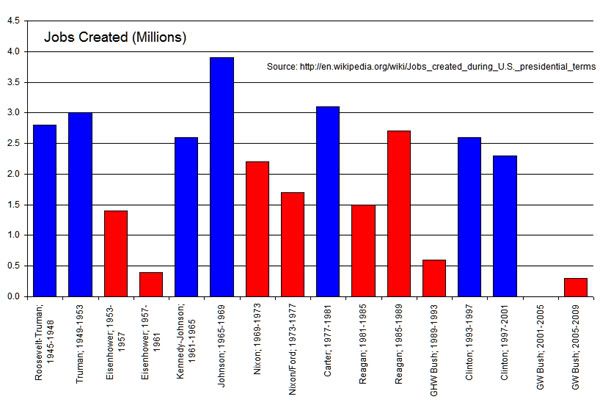
Again, the Blue columns represent Democrat (sic) administrations while the Red columns represent Republican administrations. You spend a little time studying the chart and figuring out who might have a better idea about creating jobs, how to do it and what it takes! I won't even bother to give you a hint.
There are all kinds of things that I hear on the political front that, frankly, I get tired of hearing. When I get tired enough of a mantra, I get the itch to start looking up things that will either substantiate or refute the rhetoric.
One of the things that has troubled me has been the assertion that Conservative Republicans are "fiscally responsible" while Liberal Democrats only want to "tax and spend". Its a mantra that's repeated often but, rarely is any proof offered in the discussion. I thought I'd look up the numbers. Numbers are great. They have sources that we can all refer to so that we're all singing from the same sheet, so to speak.
It struck me that the mounting National Debt (as a percentage of Gross Domestic Product) might be a good measure of overall fiscal responsibility. If we're being responsible, then logically the National Debt %GDP should be decreasing during a given administration. On the other hand, if we're being irresponsible that number should be on the rise ... that is to say, as it goes down, we're living more within our means. If it is increasing, we are borrowing and mortgaging the future of the country and of future generations. So, who has done their part to see that we're at least trying to live within our means and who has been on a spending spree?
Conventional wisdom would have it that Republican administrations, being fiscally responsible, would be the administrations that reduced our collective indebtedness while Democrats, who we all KNOW only want to "tax and spend" would be the ones who are increasing our overall debt.
The surprise is that the numbers don't support that proposition.
The graph below outlines which administrations lowered the national Debt as a percentage of GDP and which increased it relative to the previous administration. The Blue columns represent Democrat (sic) administrations between the end of World War Two (1945) and 2009. The Red columns represent Republican administrations.
The pattern becomes clear when you draw a picture of it! Every single Democrat (sic) administration since the Second World War has managed to decrease the National Debt as a percent of GDP while every Republican administration since Nixon's second term (1973-1977) has managed to raise our level of indebtedness - not just by a little - in most cases by a lot - while at the same time telling us they know how to manage money! Sort of like pissing on your head and telling you that its only raining out!
Now, the Tea Party is angry ... and they have every cause to be angry. We're in deep du-du and there's no easy way out. They're angry about the state of our indebtedness. They're angry that they have to pay taxes (though the ones who seem most angry seem to be the ones who pay the least). They're angry at Democrats because they've been told, ever since Reagan, that Democrats "tax and spend" ... and they're gullible enough to believe it without checking the numbers. They're angry with government because they've been told, ever since Reagan, that "government isn't the solution. Government is the problem!" And they've believed it ... without bothering to check the facts.
If they looked at the facts ... where the national financial problems originated ... they would be taring and feathering Republicans instead of inviting them to their rallys. If anyone is responsible for the current debt situation (touted by Republicans as something on the order of $100,000 per household, at this point) its Republicans! Their ideas about "free enterprise" ... which, as a result of their ideas of deregulation is really a free-for-all bordering on piracy have almost sunk our banking industry and have driven the nation into a deep recession.
Then they say that they know how to create jobs. So, I looked at the numbers ... because it seemed to me that when people are unemployed cutting their taxes dose nothing to put food on their tables. I looked at the Jobs Created numbers to see who, historically, might have a better idea of how to create jobs ... because the only way out of this mess is for us to earn our way out ... and the only way to earn our way out is if people - real, everyday people - have jobs.
Again, the Blue columns represent Democrat (sic) administrations while the Red columns represent Republican administrations. You spend a little time studying the chart and figuring out who might have a better idea about creating jobs, how to do it and what it takes! I won't even bother to give you a hint.
Tuesday, January 26, 2010
Monday, January 25, 2010
Problem of evil and religion's double standard
Daniel C. Dennett in The Washington Post
"One of the striking differences between modern, "organized" religion and tribal or folk religions--religions without seminaries and theologians and official books--is that in tribal religions they have no double standard! They thank their gods for the good stuff that happens and blame them for the bad. The idea that God is a worthy recipient of our gratitude for the blessings of life but should not be held accountable for the disasters is a transparently disingenuous innovation of the theologians. And of course it doesn't work all that well. The Problem of Evil, capital letters and all, is the central enigma confronting theists. There is no solution. Isn't that obvious? All the holy texts and interpretations that contrive ways of getting around the problem read like the fine print in a fraudulent contract--and for the same reason: they are desperate attempts to conceal the implications of the double standard they have invented."
Read more in The Washington Post after the click ...
"One of the striking differences between modern, "organized" religion and tribal or folk religions--religions without seminaries and theologians and official books--is that in tribal religions they have no double standard! They thank their gods for the good stuff that happens and blame them for the bad. The idea that God is a worthy recipient of our gratitude for the blessings of life but should not be held accountable for the disasters is a transparently disingenuous innovation of the theologians. And of course it doesn't work all that well. The Problem of Evil, capital letters and all, is the central enigma confronting theists. There is no solution. Isn't that obvious? All the holy texts and interpretations that contrive ways of getting around the problem read like the fine print in a fraudulent contract--and for the same reason: they are desperate attempts to conceal the implications of the double standard they have invented."
Read more in The Washington Post after the click ...
Wednesday, January 13, 2010
Guantanamo guard reunited with ex-inmates
Why would a former Guantanamo Bay prison guard track down two of his former captives - two British men - and agree to fly to London to meet them?
"You look different without a cap."
"You look different without the jump suits."
With those words, an extraordinary reunion gets under way.
... catch the video from BBC after the click.
"You look different without a cap."
"You look different without the jump suits."
With those words, an extraordinary reunion gets under way.
... catch the video from BBC after the click.
Monday, January 11, 2010
The Bull and the Bull Fighter
The "war on terrorism" is a significant example of the effectiveness of asymmetrical strategies; the "David and Goliath Effect". Like toreadors, waving a cape at a raging bull in the bull ring, al-Qaeda fields a single operative with explosives in his underwear at the cost of a plane ticket and we spend a billion dollars installing scanning machines in airports all over the country.
Al-Qaeda abandons Afghanistan for the tribal regions of Pakistan leaving us to spend billions of dollars fighting the Taliban who's goals don't extend beyond the national boundaries of Afghanistan. Al-Qaeda's cost is next to nothing but the cost to us is immeasurable.
A large military presence in a foreign country only serves to inflame indigenous resentments. Our presence in Iraq and in Afghanistan is a recruiting tool that al-Qaeda could only imagine in their wildest dreams and, over the better part of the last decade, they've learned how to push the right buttons to keep things going.
They don't need to "win". They only need to keep us chasing our tails to achieve their goal of driving us to bankruptcy. For them to merely survive is the big win for them.
We cannot "win" as long as we continue trying to "fight terrorism" on their terms ... as long as we pursue al-Qaeda as if it were a military entity by putting our military force into the field we are playing to their strengths. Like the art of jujitsu, they are using our sheer weight against us. They count on our macho bravodo that dictates, once committed, we cannot back away. Like a bull in a bull ring, we cannot stop chasing the illusive capes.
Al-Qaeda abandons Afghanistan for the tribal regions of Pakistan leaving us to spend billions of dollars fighting the Taliban who's goals don't extend beyond the national boundaries of Afghanistan. Al-Qaeda's cost is next to nothing but the cost to us is immeasurable.
A large military presence in a foreign country only serves to inflame indigenous resentments. Our presence in Iraq and in Afghanistan is a recruiting tool that al-Qaeda could only imagine in their wildest dreams and, over the better part of the last decade, they've learned how to push the right buttons to keep things going.
They don't need to "win". They only need to keep us chasing our tails to achieve their goal of driving us to bankruptcy. For them to merely survive is the big win for them.
We cannot "win" as long as we continue trying to "fight terrorism" on their terms ... as long as we pursue al-Qaeda as if it were a military entity by putting our military force into the field we are playing to their strengths. Like the art of jujitsu, they are using our sheer weight against us. They count on our macho bravodo that dictates, once committed, we cannot back away. Like a bull in a bull ring, we cannot stop chasing the illusive capes.
Subscribe to:
Posts (Atom)