Showing posts with label future. Show all posts
Showing posts with label future. Show all posts
Saturday, February 25, 2012


Monday, July 18, 2011
Antiscientists are leading America down a dangerous road
Today's GOP antiscience fervor is somewhat new for America. The last time it got close was about a century ago, when the Democrats went antiscience under the leadership of anti-evolution campaigner William Jennings Bryan. Back then, the Republicans were the party of science, reason, finance, environmentalism and progressivism.
But even then, things weren't as virulent as they are now, because the push was coming mostly from Southern social and religious conservatives, while today those conservatives are joined by the vested interests and deep pockets of big business. This is driving almost all of the new GOP freshmen lawmakers to take positions that are vehemently anti-climate science, pro-creationism, pro-abstinence only education, and seeking to personally vilify, harrass and attack scientists for their own political gain.
This has never been a successful strategy, and today's GOP should abandon it. Americans should support Republican candidates that are pro-science. Nations that have strayed too far down the path of placing ideology ahead of science have come out losers, both economically and in terms of global power. Consider these examples from history, that are eerily echoed in today's antiscience politics:
Read the rest on Neorenaissance ...
But even then, things weren't as virulent as they are now, because the push was coming mostly from Southern social and religious conservatives, while today those conservatives are joined by the vested interests and deep pockets of big business. This is driving almost all of the new GOP freshmen lawmakers to take positions that are vehemently anti-climate science, pro-creationism, pro-abstinence only education, and seeking to personally vilify, harrass and attack scientists for their own political gain.
This has never been a successful strategy, and today's GOP should abandon it. Americans should support Republican candidates that are pro-science. Nations that have strayed too far down the path of placing ideology ahead of science have come out losers, both economically and in terms of global power. Consider these examples from history, that are eerily echoed in today's antiscience politics:
Read the rest on Neorenaissance ...
Thursday, June 04, 2009
President Obama Hits All the Right Notes in Cairo
by Joseph Palermo on HuffPo
President Barack Obama's speech today in Cairo hit all of the right notes and was exactly what he needed to say after eight years of saber rattling, racist diatribes about "Crusades," and Biblical quotes affixed to "Worldwide Intelligence Updates." For years we've heard mouthpieces from the American Right uttering every offensive slur against Arabs and Muslims imaginable. Obama's contrast in tone as he addressed directly the world's 1.2 billion Muslims could not have been further from the toxic mixture of arrogance and incompetence that characterized the Bush-Cheney years.
... read the rest on Huffington Post after the click.
President Barack Obama's speech today in Cairo hit all of the right notes and was exactly what he needed to say after eight years of saber rattling, racist diatribes about "Crusades," and Biblical quotes affixed to "Worldwide Intelligence Updates." For years we've heard mouthpieces from the American Right uttering every offensive slur against Arabs and Muslims imaginable. Obama's contrast in tone as he addressed directly the world's 1.2 billion Muslims could not have been further from the toxic mixture of arrogance and incompetence that characterized the Bush-Cheney years.
... read the rest on Huffington Post after the click.
Tuesday, March 17, 2009
One Second before Midnight
by Al Petrone
Science tells us the earth is over 4.7 billion years old, with all of modern history and human civilization only occurring within the last 5,000 to 10,000 years. Said differently, if all of time were compared to a 12 month calendar, ALL of mankind's recorded history would have occurred on the last second, of the last minute, of the last day of that year. Using our universal timeline as an analogy, everything we know as humans has transpired at 11:59PM on December 31st .... all in less than one second. All of the world's cultures, languages, countries, empires, governments, religions, stories, songs and dreams that have ever come and gone - and those that are still here ....have all happened within this "one second before midnight". In this one blink of an eye, millions of species have appeared and disappeared off the face of the earth. One species however, evolved beyond the others, and learned to walk upright and communicate. In very short order, this same species went on to build pyramids, paint the Sistine Chapel, crack the genetic code of our DNA, and fly faster than the speed of sound. Thru their many stages of evolution, and while struggling to survive, this human species continually re-defined itself and its rightful place in the universe. As they journeyed on their many different paths thru time, they created many forms of culture and society. Along the way, each of these societies offered their own version of economic, political, judicial and religious belief systems. This resulted in the birth of numerous tribes within the species - each with their own language, their own customs, their own government, and their own Gods. Many of these forms of authority were based on birth-right, legend, inherited power, blind faith and legacy. Whether one believed the species was a "risen ape" or a "fallen angel", one thing was irrefutable: most of all human conflict had arisen thru man-made institutions....like borders, governments, religions, cultures, languages, and armies. Yes, the very same species that found the cure for polio, also created the atomic bomb. The very same species that sculpted the Statue of David and painted the Mona Lisa, also enslaved their fellow man. The very same species that wrote Hamlet and landed a man on the moon, also allowed a holocaust and several genocides to occur against their own species. History shows us that this continuous battle between good and evil has raged for thousands of years - with many of the ideas, cultures, governments, Gods and societies having come and gone in the flash of this one second before midnight.
... more on the hope for mankind after the click.
Science tells us the earth is over 4.7 billion years old, with all of modern history and human civilization only occurring within the last 5,000 to 10,000 years. Said differently, if all of time were compared to a 12 month calendar, ALL of mankind's recorded history would have occurred on the last second, of the last minute, of the last day of that year. Using our universal timeline as an analogy, everything we know as humans has transpired at 11:59PM on December 31st .... all in less than one second. All of the world's cultures, languages, countries, empires, governments, religions, stories, songs and dreams that have ever come and gone - and those that are still here ....have all happened within this "one second before midnight". In this one blink of an eye, millions of species have appeared and disappeared off the face of the earth. One species however, evolved beyond the others, and learned to walk upright and communicate. In very short order, this same species went on to build pyramids, paint the Sistine Chapel, crack the genetic code of our DNA, and fly faster than the speed of sound. Thru their many stages of evolution, and while struggling to survive, this human species continually re-defined itself and its rightful place in the universe. As they journeyed on their many different paths thru time, they created many forms of culture and society. Along the way, each of these societies offered their own version of economic, political, judicial and religious belief systems. This resulted in the birth of numerous tribes within the species - each with their own language, their own customs, their own government, and their own Gods. Many of these forms of authority were based on birth-right, legend, inherited power, blind faith and legacy. Whether one believed the species was a "risen ape" or a "fallen angel", one thing was irrefutable: most of all human conflict had arisen thru man-made institutions....like borders, governments, religions, cultures, languages, and armies. Yes, the very same species that found the cure for polio, also created the atomic bomb. The very same species that sculpted the Statue of David and painted the Mona Lisa, also enslaved their fellow man. The very same species that wrote Hamlet and landed a man on the moon, also allowed a holocaust and several genocides to occur against their own species. History shows us that this continuous battle between good and evil has raged for thousands of years - with many of the ideas, cultures, governments, Gods and societies having come and gone in the flash of this one second before midnight.
... more on the hope for mankind after the click.
Monday, February 23, 2009
How Bush's Policies in the Muslim World Played into Terrorists' Hands
from Robert Cramer:
I just returned from Jordan where I attended a seminar on Islam and American Foreign Policy. What struck me most is that the more you talk to leaders from the Muslim world - the more you study the polling of Muslim attitudes - the clearer it is that George Bush didn't just get the "War on Terror" a little wrong. The basic thrust of the "War on Terror" was 100% wrong - 180 degrees off the mark.
In fact, you could argue, that if Osama Bin Laden himself had designed the strategy, it is hard to imagine how - in its essentials - it could have done more to play into the hands of the small fraction of Muslim extremists who resort to terror.
Bush's policy seemed to presume that if the military could just track down and kill enough Islamic radicals and terrorists, terrorism could be wiped out. But even the Bush administration understood that the small, hard core of Muslim terrorists depends upon support from a much broader group of radicalized Muslims - for new recruits, for money, for protection.
... read the rest after the click. It summarizes some interesting Gallup Poll findings obtained from tens of thousands of random interviews in the Muslim world between 2001 and 2007.
Hint: They DON'T hate us for our freedoms.
I just returned from Jordan where I attended a seminar on Islam and American Foreign Policy. What struck me most is that the more you talk to leaders from the Muslim world - the more you study the polling of Muslim attitudes - the clearer it is that George Bush didn't just get the "War on Terror" a little wrong. The basic thrust of the "War on Terror" was 100% wrong - 180 degrees off the mark.
In fact, you could argue, that if Osama Bin Laden himself had designed the strategy, it is hard to imagine how - in its essentials - it could have done more to play into the hands of the small fraction of Muslim extremists who resort to terror.
Bush's policy seemed to presume that if the military could just track down and kill enough Islamic radicals and terrorists, terrorism could be wiped out. But even the Bush administration understood that the small, hard core of Muslim terrorists depends upon support from a much broader group of radicalized Muslims - for new recruits, for money, for protection.
... read the rest after the click. It summarizes some interesting Gallup Poll findings obtained from tens of thousands of random interviews in the Muslim world between 2001 and 2007.
Hint: They DON'T hate us for our freedoms.
Thursday, January 22, 2009
Inaugural Mulligan
by JOHN FEFFER / Foreign Policy In Focus
According to the British historian Eric Hobsbawm in The Age of Extremes, the 20th century didn’t truly begin until 1914. World War I, with its new technologies of violence and effective termination of several empires, brought what Hobsbawm called the “long 19th century” to a close. Those with a more scientific bent might date the beginning of the 20th century to the first flight of the Wright brothers (1903) or the first transatlantic phone call (1915). If you prefer to think of the last 100 years as dominated by Hollywood and the global image factory, the 20th century began prematurely in 1896 when the first movie premiered in New York.
The profound changes that mark an era rarely correspond to a calendar’s shifts. Even Jesus Christ came into this world several years before the millennial turning point to which he gave his name. In other words, an era dawns two ways, chronologically and metaphorically.
Our choices for the metaphorical dawn of the 21st century are rather bleak. Here are a few possibilities: the outbreak of fighting in Yugoslavia in 1991, the election of George W. Bush in 2000, the Intergovernmental Panel on Climate Change’s 2001 report on the incontrovertible evidence for global warming, the attacks of September 11, the Iraq War, and last year’s dizzying stock market crash.
If these events set the tone for this century, we are in deep trouble. We face a long economic decline, a slowly increasing heat wave, growing anarchy and violence, and lousy governance. As these trends converge, we face not the “perfect storm” but the “last storm.” We’re all living on borrowed time (which gives us the name of our epoch, according to a recent contest in The Nation).
But let’s pretend that we’ve simply gotten off on the wrong foot with this century. In a friendly round of golf, if you make a lousy tee shot, you can declare a “mulligan” and do the shot over. We’ve certainly sent the ball into the woods this time around. So let’s call a “mulligan” and start over.
... read the rest after the click.
According to the British historian Eric Hobsbawm in The Age of Extremes, the 20th century didn’t truly begin until 1914. World War I, with its new technologies of violence and effective termination of several empires, brought what Hobsbawm called the “long 19th century” to a close. Those with a more scientific bent might date the beginning of the 20th century to the first flight of the Wright brothers (1903) or the first transatlantic phone call (1915). If you prefer to think of the last 100 years as dominated by Hollywood and the global image factory, the 20th century began prematurely in 1896 when the first movie premiered in New York.
The profound changes that mark an era rarely correspond to a calendar’s shifts. Even Jesus Christ came into this world several years before the millennial turning point to which he gave his name. In other words, an era dawns two ways, chronologically and metaphorically.
Our choices for the metaphorical dawn of the 21st century are rather bleak. Here are a few possibilities: the outbreak of fighting in Yugoslavia in 1991, the election of George W. Bush in 2000, the Intergovernmental Panel on Climate Change’s 2001 report on the incontrovertible evidence for global warming, the attacks of September 11, the Iraq War, and last year’s dizzying stock market crash.
If these events set the tone for this century, we are in deep trouble. We face a long economic decline, a slowly increasing heat wave, growing anarchy and violence, and lousy governance. As these trends converge, we face not the “perfect storm” but the “last storm.” We’re all living on borrowed time (which gives us the name of our epoch, according to a recent contest in The Nation).
But let’s pretend that we’ve simply gotten off on the wrong foot with this century. In a friendly round of golf, if you make a lousy tee shot, you can declare a “mulligan” and do the shot over. We’ve certainly sent the ball into the woods this time around. So let’s call a “mulligan” and start over.
... read the rest after the click.
Tuesday, January 20, 2009
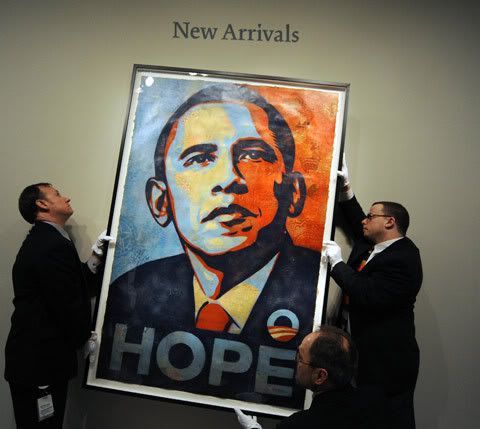
The "war on science" is over. Now what?
By Chris Mooney / Slate
The "war on science" is over. Or at least it is in the sense that I originally meant the phrase: We're at the close of the Bush administration's years of attacks on the integrity of scientific information—its biased editing of technical documents, muzzling of government researchers, and shameless dispersal of faulty ideas about issues like global warming.
...
If the war on science is over, we're now entering the postwar phase of reconstruction — the scientific equivalent of nation-building. The Bush science controversies were just one manifestation of a deeper and long-standing gulf between the science community and the broader American public, one with roots stretching back to our indigenous tradition of anti-intellectualism (as so famously described by historian Richard Hofstadter in his classic work from 1963) and Yankee distrust of expertise and authority. So this is certainly no time for complacency. Scientists, with the support of the administration, should now be setting out to win over the hearts and minds of the American public, creating a stronger edifice of trust and understanding to help ensure that conflict doesn't come raging back again.
... read the rest in Slate after the click.
The "war on science" is over. Or at least it is in the sense that I originally meant the phrase: We're at the close of the Bush administration's years of attacks on the integrity of scientific information—its biased editing of technical documents, muzzling of government researchers, and shameless dispersal of faulty ideas about issues like global warming.
...
If the war on science is over, we're now entering the postwar phase of reconstruction — the scientific equivalent of nation-building. The Bush science controversies were just one manifestation of a deeper and long-standing gulf between the science community and the broader American public, one with roots stretching back to our indigenous tradition of anti-intellectualism (as so famously described by historian Richard Hofstadter in his classic work from 1963) and Yankee distrust of expertise and authority. So this is certainly no time for complacency. Scientists, with the support of the administration, should now be setting out to win over the hearts and minds of the American public, creating a stronger edifice of trust and understanding to help ensure that conflict doesn't come raging back again.
... read the rest in Slate after the click.
Tuesday, January 13, 2009
Student auctions off virginity for offers of more than £2.5 million
File the following under "Money's tight; times are hard:"
Telegraph / UK
Natalie Dylan, 22, claims her offer of a one-night stand has persuaded 10,000 men to bid for sex with her.
Last September, when her auction came to light, she had received bids up to £162,000 ($243,000) but since then interest in her has rocketed.
The student who has a degree in Women's Studies insisted she was not demeaning herself.
Miss Dylan, from San Diego, California, USA, said she was persuaded to offer herself to the highest bidder after her sister Avia, 23, paid for her own degree after working as a prostitute for three weeks.
... more from the Telegraph after the click.
My comment: Every once in a while I'm reminded of the many reasons I chose to name this blog what I named this blog ...
Telegraph / UK
Natalie Dylan, 22, claims her offer of a one-night stand has persuaded 10,000 men to bid for sex with her.
Last September, when her auction came to light, she had received bids up to £162,000 ($243,000) but since then interest in her has rocketed.
The student who has a degree in Women's Studies insisted she was not demeaning herself.
Miss Dylan, from San Diego, California, USA, said she was persuaded to offer herself to the highest bidder after her sister Avia, 23, paid for her own degree after working as a prostitute for three weeks.
... more from the Telegraph after the click.
My comment: Every once in a while I'm reminded of the many reasons I chose to name this blog what I named this blog ...
Sunday, January 04, 2009
The Next Next Things
The Washington Post
With its power to send knowledge around the globe at lightning speed, information technology has vastly changed our world — unleashing the Internet along with a global economy of knowledge workers and even, some would say, sparking the fall of communism and the rise of terrorism. Computer power has increased exponentially since 1980, when machines less sophisticated than your cellphone filled entire rooms. And we can expect similar mindboggling advances in the coming decades.
... boggle your mind a little with the Washington Post after the click.
My comment: Its hard to see the changes from day to day. It seems you have to step back a little to get a bit of perspective. My father was born in 1912 and passed away in 1991. During the course of his life he witnessed two World Wars, The Great Depression, the Atomic Bomb, the advent of the computer age and man walking on the moon. When he was born, flight meant a noisy biplane with a flight range on the order of the wing span of today's 747 and an altitude you could throw rocks at. In 1990, the year before he died, the SR-71 set a flight speed record of 2,124 mph and a sustained altitude record of 85,069 feet on a coast-to-coast, NY to LA flight. As a boy, he made hay and plowed fields with a team of horses. Today, the family farm is pretty much a thing of the past in "developed" countries; replaced by "agri-businesses" and factory farms. The house he lived in as a child was heated by wood and the wood came from a twenty acre wood lot at the far end of the 140 acre farm he lived on. The "bathroom" consisted of an outhouse behind the wood shed and a galvanized tub filled with water boiled on the wood cook stove in the kitchen. Running water involved a pump handle that one exercised in an up and down motion ... with some effort. I know because that's where my life started in 1945.
My generation invented the Internet, digital watches, compact discs, MP3 files, cable and satellite TV as well as a host of other "necessities" that didn't exist, even in dreams, when I was born.
The change that occurred during my father's lifetime was significantly faster and more far reaching that the change that effected his father and the previous generation. But as different as things were comparing life at the beginning of my father's journey with the way things were at the end, the change we are experiencing now is even greater and moving much faster ... with no sign of letting up any time soon.
I wonder what price we've paid for the gain.
With its power to send knowledge around the globe at lightning speed, information technology has vastly changed our world — unleashing the Internet along with a global economy of knowledge workers and even, some would say, sparking the fall of communism and the rise of terrorism. Computer power has increased exponentially since 1980, when machines less sophisticated than your cellphone filled entire rooms. And we can expect similar mindboggling advances in the coming decades.
... boggle your mind a little with the Washington Post after the click.
My comment: Its hard to see the changes from day to day. It seems you have to step back a little to get a bit of perspective. My father was born in 1912 and passed away in 1991. During the course of his life he witnessed two World Wars, The Great Depression, the Atomic Bomb, the advent of the computer age and man walking on the moon. When he was born, flight meant a noisy biplane with a flight range on the order of the wing span of today's 747 and an altitude you could throw rocks at. In 1990, the year before he died, the SR-71 set a flight speed record of 2,124 mph and a sustained altitude record of 85,069 feet on a coast-to-coast, NY to LA flight. As a boy, he made hay and plowed fields with a team of horses. Today, the family farm is pretty much a thing of the past in "developed" countries; replaced by "agri-businesses" and factory farms. The house he lived in as a child was heated by wood and the wood came from a twenty acre wood lot at the far end of the 140 acre farm he lived on. The "bathroom" consisted of an outhouse behind the wood shed and a galvanized tub filled with water boiled on the wood cook stove in the kitchen. Running water involved a pump handle that one exercised in an up and down motion ... with some effort. I know because that's where my life started in 1945.
My generation invented the Internet, digital watches, compact discs, MP3 files, cable and satellite TV as well as a host of other "necessities" that didn't exist, even in dreams, when I was born.
The change that occurred during my father's lifetime was significantly faster and more far reaching that the change that effected his father and the previous generation. But as different as things were comparing life at the beginning of my father's journey with the way things were at the end, the change we are experiencing now is even greater and moving much faster ... with no sign of letting up any time soon.
I wonder what price we've paid for the gain.
Monday, December 29, 2008
Unrest caused by bad economy may require military action, report says
By Diana Washington Valdez / El Paso Times
EL PASO -- A U.S. Army War College report warns an economic crisis in the United States could lead to massive civil unrest and the need to call on the military to restore order.
Retired Army Lt. Col. Nathan Freir wrote the report "Known Unknowns: Unconventional Strategic Shocks in Defense Strategy Development," which the Army think tank in Carlisle, Pa., recently released.
"Widespread civil violence inside the United States would force the defense establishment to reorient priorities ... to defend basic domestic order and human security," the report said, in case of "unforeseen economic collapse," "pervasive public health emergencies," and "catastrophic natural and human disasters," among other possible crises.
... more in the El Paso Times after the click.
My comment: Fasten your seat belts, kids.
EL PASO -- A U.S. Army War College report warns an economic crisis in the United States could lead to massive civil unrest and the need to call on the military to restore order.
Retired Army Lt. Col. Nathan Freir wrote the report "Known Unknowns: Unconventional Strategic Shocks in Defense Strategy Development," which the Army think tank in Carlisle, Pa., recently released.
"Widespread civil violence inside the United States would force the defense establishment to reorient priorities ... to defend basic domestic order and human security," the report said, in case of "unforeseen economic collapse," "pervasive public health emergencies," and "catastrophic natural and human disasters," among other possible crises.
... more in the El Paso Times after the click.
My comment: Fasten your seat belts, kids.
Sunday, December 28, 2008
As if Things Weren't Bad Enough, Russian Professor Predicts End of U.S.
Wall Street Journal
By ANDREW OSBORN
MOSCOW -- For a decade, Russian academic Igor Panarin has been predicting the U.S. will fall apart in 2010. For most of that time, he admits, few took his argument -- that an economic and moral collapse will trigger a civil war and the eventual breakup of the U.S. -- very seriously. Now he's found an eager audience: Russian state media.
In recent weeks, he's been interviewed as much as twice a day about his predictions. "It's a record," says Prof. Panarin. "But I think the attention is going to grow even stronger."
Prof. Panarin, 50 years old, is not a fringe figure. A former KGB analyst, he is dean of the Russian Foreign Ministry's academy for future diplomats. He is invited to Kremlin receptions, lectures students, publishes books, and appears in the media as an expert on U.S.-Russia relations.
But it's his bleak forecast for the U.S. that is music to the ears of the Kremlin, which in recent years has blamed Washington for everything from instability in the Middle East to the global financial crisis. Mr. Panarin's views also fit neatly with the Kremlin's narrative that Russia is returning to its rightful place on the world stage after the weakness of the 1990s, when many feared that the country would go economically and politically bankrupt and break into separate territories.
A polite and cheerful man with a buzz cut, Mr. Panarin insists he does not dislike Americans. But he warns that the outlook for them is dire.
"There's a 55-45% chance right now that disintegration will occur," he says. "One could rejoice in that process," he adds, poker-faced. "But if we're talking reasonably, it's not the best scenario -- for Russia." Though Russia would become more powerful on the global stage, he says, its economy would suffer because it currently depends heavily on the dollar and on trade with the U.S.
Mr. Panarin posits, in brief, that mass immigration, economic decline, and moral degradation will trigger a civil war next fall and the collapse of the dollar. Around the end of June 2010, or early July, he says, the U.S. will break into six pieces -- with Alaska reverting to Russian control.
...
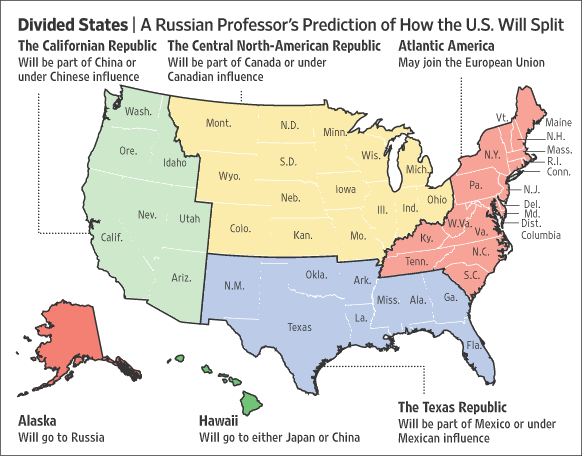
California will form the nucleus of what he calls "The Californian Republic," and will be part of China or under Chinese influence. Texas will be the heart of "The Texas Republic," a cluster of states that will go to Mexico or fall under Mexican influence. Washington, D.C., and New York will be part of an "Atlantic America" that may join the European Union. Canada will grab a group of Northern states Prof. Panarin calls "The Central North American Republic." Hawaii, he suggests, will be a protectorate of Japan or China, and Alaska will be subsumed into Russia.
"It would be reasonable for Russia to lay claim to Alaska; it was part of the Russian Empire for a long time." A framed satellite image of the Bering Strait that separates Alaska from Russia like a thread hangs from his office wall. "It's not there for no reason," he says with a sly grin.
My comment: ... and Sarah Palin can see Russia from her house ... read the rest in the Wall Street Journal after the click.
By ANDREW OSBORN
MOSCOW -- For a decade, Russian academic Igor Panarin has been predicting the U.S. will fall apart in 2010. For most of that time, he admits, few took his argument -- that an economic and moral collapse will trigger a civil war and the eventual breakup of the U.S. -- very seriously. Now he's found an eager audience: Russian state media.
In recent weeks, he's been interviewed as much as twice a day about his predictions. "It's a record," says Prof. Panarin. "But I think the attention is going to grow even stronger."
Prof. Panarin, 50 years old, is not a fringe figure. A former KGB analyst, he is dean of the Russian Foreign Ministry's academy for future diplomats. He is invited to Kremlin receptions, lectures students, publishes books, and appears in the media as an expert on U.S.-Russia relations.
But it's his bleak forecast for the U.S. that is music to the ears of the Kremlin, which in recent years has blamed Washington for everything from instability in the Middle East to the global financial crisis. Mr. Panarin's views also fit neatly with the Kremlin's narrative that Russia is returning to its rightful place on the world stage after the weakness of the 1990s, when many feared that the country would go economically and politically bankrupt and break into separate territories.
A polite and cheerful man with a buzz cut, Mr. Panarin insists he does not dislike Americans. But he warns that the outlook for them is dire.
"There's a 55-45% chance right now that disintegration will occur," he says. "One could rejoice in that process," he adds, poker-faced. "But if we're talking reasonably, it's not the best scenario -- for Russia." Though Russia would become more powerful on the global stage, he says, its economy would suffer because it currently depends heavily on the dollar and on trade with the U.S.
Mr. Panarin posits, in brief, that mass immigration, economic decline, and moral degradation will trigger a civil war next fall and the collapse of the dollar. Around the end of June 2010, or early July, he says, the U.S. will break into six pieces -- with Alaska reverting to Russian control.
...
California will form the nucleus of what he calls "The Californian Republic," and will be part of China or under Chinese influence. Texas will be the heart of "The Texas Republic," a cluster of states that will go to Mexico or fall under Mexican influence. Washington, D.C., and New York will be part of an "Atlantic America" that may join the European Union. Canada will grab a group of Northern states Prof. Panarin calls "The Central North American Republic." Hawaii, he suggests, will be a protectorate of Japan or China, and Alaska will be subsumed into Russia.
"It would be reasonable for Russia to lay claim to Alaska; it was part of the Russian Empire for a long time." A framed satellite image of the Bering Strait that separates Alaska from Russia like a thread hangs from his office wall. "It's not there for no reason," he says with a sly grin.
My comment: ... and Sarah Palin can see Russia from her house ... read the rest in the Wall Street Journal after the click.
Friday, November 14, 2008
There is nothing new under the sun ...
... and that's why its so vital for one to read the classics if one wishes to consider himself educated.
from Amb. Alexandros P. Mallias, Greek Ambassador to the United States (on Huffington Post):
Along with millions of people around the world, I, too, watched as President-elect Barack Obama graciously thanked the American people for voting him into the highest office in the land. His was an inspiring message of change and hope; in a sweeping estimation of the work ahead, Barack Obama's words resounded and reached us as distinct individuals, we singled out those words more relevant to each one of us.
As Greece's Ambassador to the United States, representing the world's first democracy in the world's current most powerful democracy, some of his words spoke particularly to me, when he said that America's "true strength... comes not from the might of our arms or the scale of our wealth, but from the enduring power of our ideals".
Considering the man, I was not surprised to hear him speak these words, reminiscent of the writings of one ancient Greek in particular, Isocrates, one of Greece's greatest orators. In his oration "On Peace", Isocrates proposes to the Athenian assembly policies for lasting peace with their neighbors. Along with suggestions, it is also recorded in the most relevant and timeless handbook, Thucydides' "History of the Peloponnesian Wars," written some 2,500 years ago. From this timeless text, one can draw lessons on how to treat allies, how to prepare for war, on the value of good advisors, warnings as to the arrogance, as well as the limits of power.
One of the most important lessons in this oration is that justice and interest, two seemingly irreconcilable concepts, are not mutually exclusive. Isocrates argues that justice, while making us better individuals, better nations, is at the same time a means of protecting one's self interest; power without justice leads to ill repute; power without justice will not win allies. He asserts that maintenance of power presupposes the existence of justice.
... there's more after the click.
As an afterthought, (and for what it's worth) the following is a short list of my previous blog references to the classics:
from Amb. Alexandros P. Mallias, Greek Ambassador to the United States (on Huffington Post):
Along with millions of people around the world, I, too, watched as President-elect Barack Obama graciously thanked the American people for voting him into the highest office in the land. His was an inspiring message of change and hope; in a sweeping estimation of the work ahead, Barack Obama's words resounded and reached us as distinct individuals, we singled out those words more relevant to each one of us.
As Greece's Ambassador to the United States, representing the world's first democracy in the world's current most powerful democracy, some of his words spoke particularly to me, when he said that America's "true strength... comes not from the might of our arms or the scale of our wealth, but from the enduring power of our ideals".
Considering the man, I was not surprised to hear him speak these words, reminiscent of the writings of one ancient Greek in particular, Isocrates, one of Greece's greatest orators. In his oration "On Peace", Isocrates proposes to the Athenian assembly policies for lasting peace with their neighbors. Along with suggestions, it is also recorded in the most relevant and timeless handbook, Thucydides' "History of the Peloponnesian Wars," written some 2,500 years ago. From this timeless text, one can draw lessons on how to treat allies, how to prepare for war, on the value of good advisors, warnings as to the arrogance, as well as the limits of power.
One of the most important lessons in this oration is that justice and interest, two seemingly irreconcilable concepts, are not mutually exclusive. Isocrates argues that justice, while making us better individuals, better nations, is at the same time a means of protecting one's self interest; power without justice leads to ill repute; power without justice will not win allies. He asserts that maintenance of power presupposes the existence of justice.
... there's more after the click.
As an afterthought, (and for what it's worth) the following is a short list of my previous blog references to the classics:
Sunday, November 09, 2008
The Pundits on the Right
... are telling us that we're still a "center-right" country.
Except for our collective views on:
-- Health care
-- Reproductive choice
-- Energy independence
-- Climate change
-- Civil rights
-- Economic policy
-- Stem cell research
-- Educational policy
-- The war in Iraq
-- and our view that government should try to do more rather than less
What ever it is that they're smoking ... I wish I had some.
from Frank Rich in the New York Times:
... the rest after the click.
Of course, some on the Right feel a need to respond:
... the rest after the click.
Except for our collective views on:
-- Health care
-- Reproductive choice
-- Energy independence
-- Climate change
-- Civil rights
-- Economic policy
-- Stem cell research
-- Educational policy
-- The war in Iraq
-- and our view that government should try to do more rather than less
What ever it is that they're smoking ... I wish I had some.
from Frank Rich in the New York Times:
"For eight years, we’ve been told by those in power that we are small, bigoted and stupid — easily divided and easily frightened. This was the toxic catechism of Bush-Rove politics. It was the soiled banner picked up by the sad McCain campaign, and it was often abetted by an amen corner in the dominant news media. We heard this slander of America so often that we all started to believe it, liberals most certainly included. If I had a dollar for every Democrat who told me there was no way that Americans would ever turn against the war in Iraq or definitively reject Bush governance or elect a black man named Barack Hussein Obama president, I could almost start to recoup my 401(k). Few wanted to take yes for an answer.
"So let’s be blunt. Almost every assumption about America that was taken as a given by our political culture on Tuesday morning was proved wrong by Tuesday night."
... the rest after the click.
Of course, some on the Right feel a need to respond:
"A family who had supported Barack Obama's presidential campaign emerged from their home in the northwestern New Jersey town of Hardwick Thursday morning to find the charred remnants of a 6-foot wooden cross on their front lawn."
... the rest after the click.
Wednesday, November 05, 2008
The Times, They Are a' Changin'
Unlike the Bush offer in 2000 to extend his hand across the aisle ... a hand equipped with a novelty store buzzer, Obama makes a sincere offer to WORK at uniting the country ... because it will take all of us working together to survive these trying times.
"Change has come to America" speech, Chicago.
What a relief it is ... what a breath of fresh air ... to have an articulate President who knows what he's talking about and can communicate his understanding in clear, comprehensible sentences.
My faith in the humanity of people in general has been restored. My faith in democracy has been resurrected. My hope for the future has been buttressed.
... and, yes, facts DO have a liberal bias.
The future of the Republican party is uncertain. I predict that the blame for their loss will fall squarely on McCain and Palin. Fingers will be pointed at the ineptitude of the campaign and the McCain campaign's inability to even find a clear message, much less stick to one. It will all be true as far as it goes but the blame for this massive failure on the right will not go far enough. Few on the right will question the basic premises of the Republican party ... their support for unrestricted, unregulated free market capitalism, their belief that raw, bullying militarism is the answer to all international issues, or their reliance on the politics of division.
Until those items of the platform are questioned, the party will continue to fade into irrelevance.
I can almost feel sorry for those on the right ... almost, but not quite. If they have been wounded, the wounds are self inflicted. With over thirty years to "get it right", they actively chose the path that brought them to this point in history.
"Change has come to America" speech, Chicago.
What a relief it is ... what a breath of fresh air ... to have an articulate President who knows what he's talking about and can communicate his understanding in clear, comprehensible sentences.
My faith in the humanity of people in general has been restored. My faith in democracy has been resurrected. My hope for the future has been buttressed.
... and, yes, facts DO have a liberal bias.
The future of the Republican party is uncertain. I predict that the blame for their loss will fall squarely on McCain and Palin. Fingers will be pointed at the ineptitude of the campaign and the McCain campaign's inability to even find a clear message, much less stick to one. It will all be true as far as it goes but the blame for this massive failure on the right will not go far enough. Few on the right will question the basic premises of the Republican party ... their support for unrestricted, unregulated free market capitalism, their belief that raw, bullying militarism is the answer to all international issues, or their reliance on the politics of division.
Until those items of the platform are questioned, the party will continue to fade into irrelevance.
I can almost feel sorry for those on the right ... almost, but not quite. If they have been wounded, the wounds are self inflicted. With over thirty years to "get it right", they actively chose the path that brought them to this point in history.
Sunday, November 02, 2008
Tapping the Vortex for Green Energy
WIRED
A bane of Big Oil's offshore rigs could become a boon for renewable energy.
By tapping the natural motion of slow-moving water, a new hydrokinetic generator could open vast new swaths of the ocean for energy production.
When ocean currents flow over any kind of cylinder, like the long cables that hold drilling platforms in place, small vortices are created. They eventually spin away, or shed, causing vibrations that over time can destroy an oil rig's moorings.
Now, a University of Michigan engineer who long worked on suppressing this phenomenon, has developed a prototype energy-harvester that can capture the mechanical energy it creates.
... the rest after the click.
A bane of Big Oil's offshore rigs could become a boon for renewable energy.
By tapping the natural motion of slow-moving water, a new hydrokinetic generator could open vast new swaths of the ocean for energy production.
When ocean currents flow over any kind of cylinder, like the long cables that hold drilling platforms in place, small vortices are created. They eventually spin away, or shed, causing vibrations that over time can destroy an oil rig's moorings.
Now, a University of Michigan engineer who long worked on suppressing this phenomenon, has developed a prototype energy-harvester that can capture the mechanical energy it creates.
... the rest after the click.
Saturday, November 01, 2008
Throwing an Election, Part 2
Have you noticed, as I think I have, that every time McCain appears to be getting a little traction, another heavy weight Republican endorses Obama? Why do they do it at this point in the game? It seems to me they have the option of silence.
I'm fully convinced that the Republican Party gave McCain the nod in exchange for his backing Bush policies ... they gave him the nod to run ... not to win. I believe they went into the election seeing the hand writing on the wall, that it simply wasn't going to be a Republican year. Even if there was a chance to win, it wouldn't be a very good political move to win this one. Whoever takes the office is in for a rough ride. I speculate that the thinking went something like this:
Lets let the Democrats win this one. It is a virtually impossible task to manage the foreign relations issues, oversee two wars AND fix the economy after the fiasco of the last eight years. When the wheels come off, and there's a good change they will, come back in 2012 with a bag full of "We told ya so". In the meantime, they get to make an object lesson of McCain and his maverick ways. Let him run into a crushing defeat. If he looks like he's going to get up from the mat during the fight, give him a swift kick in the jewels. If he looks like he's getting some traction, send out another Republican to make headlines endorsing Obama. It kills two birds with one stone. It leaves the Democrats holding the bag with the added advantage of demonstrating what happens when you buck the party line. They've hung McCain out to dry.
I wonder who really pointed McCain at the Caribou Barbie? She has certainly proved to be a political boat anchor.
I think the Congressional races have been a surprise but still ... "We told ya so" in 2012.
Maybe I'm being paranoid but elephants are reputed to have a long memories.
I'm fully convinced that the Republican Party gave McCain the nod in exchange for his backing Bush policies ... they gave him the nod to run ... not to win. I believe they went into the election seeing the hand writing on the wall, that it simply wasn't going to be a Republican year. Even if there was a chance to win, it wouldn't be a very good political move to win this one. Whoever takes the office is in for a rough ride. I speculate that the thinking went something like this:
Lets let the Democrats win this one. It is a virtually impossible task to manage the foreign relations issues, oversee two wars AND fix the economy after the fiasco of the last eight years. When the wheels come off, and there's a good change they will, come back in 2012 with a bag full of "We told ya so". In the meantime, they get to make an object lesson of McCain and his maverick ways. Let him run into a crushing defeat. If he looks like he's going to get up from the mat during the fight, give him a swift kick in the jewels. If he looks like he's getting some traction, send out another Republican to make headlines endorsing Obama. It kills two birds with one stone. It leaves the Democrats holding the bag with the added advantage of demonstrating what happens when you buck the party line. They've hung McCain out to dry.
I wonder who really pointed McCain at the Caribou Barbie? She has certainly proved to be a political boat anchor.
I think the Congressional races have been a surprise but still ... "We told ya so" in 2012.
Maybe I'm being paranoid but elephants are reputed to have a long memories.
Sunday, October 12, 2008
Political Mergers: Nazis and Republicans Singing Kumbaya Around the Burning Cross
Given that the current economic upheaval is being compared to the Great Depression of the 1930s and that was presaged by economic the upheavals in Germany during the 1920s that resulted from their defeat in the First World War, I thought the following piece from Jesus' General was an interesting perspective and analysis.
Comparisons between Nazis and Republicans are sometimes appropriate and sometimes inappropriate, but in all cases it's only supposed to be on an abstracted level that compares polices or attitudes. The comparisons aren't supposed to be direct and immediate because Republicans aren't supposed to be actual Nazis or actual fascists, yet in their struggle to overcome all possibility of satirization, Republicans appear to be trying to become just that. In some cases, Republicans are accepting genuine neo-Nazi white supremacists in leadership roles in the Party. In other cases, rank-and-file Republicans are expressing Nazi-like hatred of outsiders and minorities that would give even Himmler warm fuzzies.
The most outrageous example would be the two elected Republican precinct delegates in Michigan who are genuine neo-Nazis. One, Kyle Bristow, openly embraces the support of the Council for Conservative Citizens and the designation of his blog as "pro-white." Better known examples would be the behavior of people attending the campaign rallies for John McCain and Sarah Palin.
Their conservative "base" is shouting out that Obama is a "terrorist" who should be "killed" and that he is guilty of "treason." At another McCain/Palin event, one conservative family brought an Obama doll to show that he's a "puppet," but their child was explicitly instructed that "you need gloves" just to touch it. In addition to the "terrorist" label we also find him being called a "Communist and a Marxist." Given how conservative his economic policies are, I don't think American conservatives know what real communism is anymore.
... the rest after the click.
They say "it can't happen here" but that's only because they are not aware of how insidious scapegoating and xenophobia can be. Couple this with events over the last eight years that have seen an erosion of he Constitution, the raising of large private armies (Blackwater, in particular), concentration camps (Gitmo) and the rise of a self perpetuating military-industrial complex - the time is ripe for a change - and not necessarily a change for the better. It can happen here. It's as simple as that.
Comparisons between Nazis and Republicans are sometimes appropriate and sometimes inappropriate, but in all cases it's only supposed to be on an abstracted level that compares polices or attitudes. The comparisons aren't supposed to be direct and immediate because Republicans aren't supposed to be actual Nazis or actual fascists, yet in their struggle to overcome all possibility of satirization, Republicans appear to be trying to become just that. In some cases, Republicans are accepting genuine neo-Nazi white supremacists in leadership roles in the Party. In other cases, rank-and-file Republicans are expressing Nazi-like hatred of outsiders and minorities that would give even Himmler warm fuzzies.
The most outrageous example would be the two elected Republican precinct delegates in Michigan who are genuine neo-Nazis. One, Kyle Bristow, openly embraces the support of the Council for Conservative Citizens and the designation of his blog as "pro-white." Better known examples would be the behavior of people attending the campaign rallies for John McCain and Sarah Palin.
Their conservative "base" is shouting out that Obama is a "terrorist" who should be "killed" and that he is guilty of "treason." At another McCain/Palin event, one conservative family brought an Obama doll to show that he's a "puppet," but their child was explicitly instructed that "you need gloves" just to touch it. In addition to the "terrorist" label we also find him being called a "Communist and a Marxist." Given how conservative his economic policies are, I don't think American conservatives know what real communism is anymore.
... the rest after the click.
They say "it can't happen here" but that's only because they are not aware of how insidious scapegoating and xenophobia can be. Couple this with events over the last eight years that have seen an erosion of he Constitution, the raising of large private armies (Blackwater, in particular), concentration camps (Gitmo) and the rise of a self perpetuating military-industrial complex - the time is ripe for a change - and not necessarily a change for the better. It can happen here. It's as simple as that.
Thursday, October 09, 2008
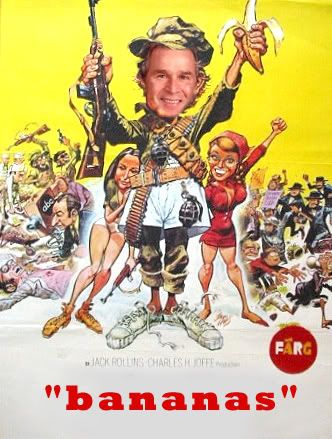
The US goes Bananas
Andrew Sullivan / Vanity Fair
In a statement on the huge state-sponsored salvage of private bankruptcy that was first proposed last September, a group of Republican lawmakers, employing one of the very rudest words in their party’s thesaurus, described the proposed rescue of the busted finance and discredited credit sectors as “socialistic.” There was a sort of half-truth to what they said. But they would have been very much nearer the mark—and rather more ironic and revealing at their own expense—if they had completed the sentence and described the actual situation as what it is: “socialism for the rich and free enterprise for the rest.”
I have heard arguments about whether it was Milton Friedman or Gore Vidal who first came up with this apt summary of a collusion between the overweening state and certain favored monopolistic concerns, whereby the profits can be privatized and the debts conveniently socialized, but another term for the same system would be “banana republic.”
... the rest after the click.
Wednesday, March 26, 2008
Subscribe to:
Posts (Atom)